Music Education for Child Development: A Holistic Parent’s Guide (2026)
Search term: music education for child development
Word Count: 3,357 words
Created: Jun 16, 2026
Music Education for Child Development: A Holistic Parent’s Guide (2026)
Search term: music education for child development
Word Count: 3,357 words
Created: Jun 16, 2026
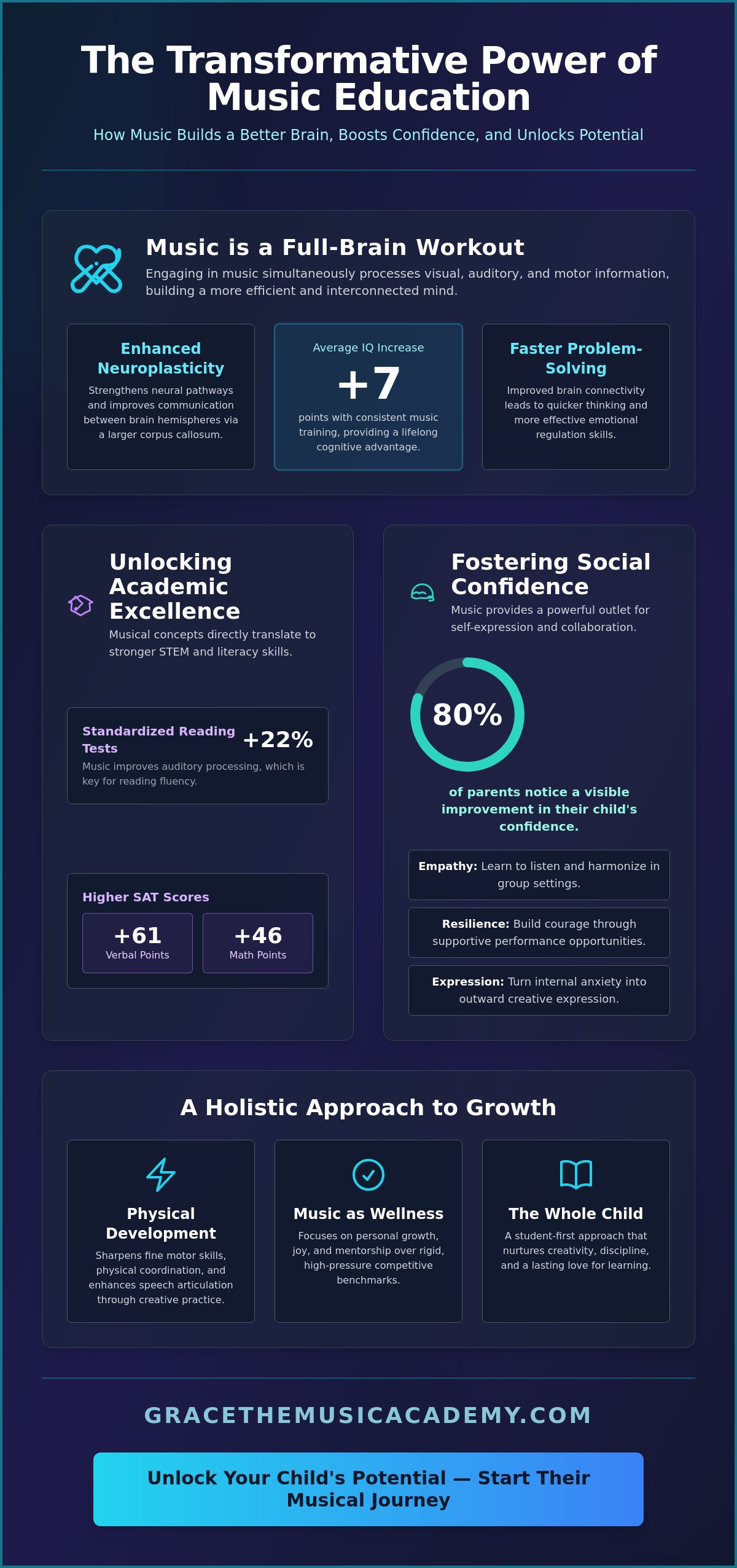
What if the key to your child's focus and social confidence wasn't found on a screen, but inside a melody? You likely feel the constant pull of digital distractions and want a more meaningful way for your child to connect with themselves and others. It's natural to seek a supportive environment that prioritizes personal growth over rigid, high-pressure benchmarks. Understanding the impact of music education for child development is the first step toward unlocking that potential. Recent studies from early 2026 show that students involved in music score 22% higher on standardized reading tests; it's a powerful tool for academic and personal success!
In this guide, you'll discover how music transforms your child's brain, emotions, and social skills through a holistic, student-first lens. We're moving beyond technical drills to focus on the whole child. You'll learn about the latest breakthroughs in neuroplasticity, including how consistent training can increase IQ by an average of 7 points. We will also explore how a non-competitive learning journey builds the discipline and joy your child needs to thrive. Let's start this journey toward creative expression and lasting confidence together.
Key Takeaways
Understand how music acts as a full-brain workout to strengthen neural pathways and enhance neuroplasticity during your child's peak development years.
Explore the powerful role of music education for child development in fostering emotional regulation and building authentic social confidence.
Discover how instrumental and vocal training sharpen physical coordination and speech articulation through engaging, creative practice.
Shift your perspective toward a music as wellness model that values personal growth and mentorship over rigid, competitive benchmarks.
Learn exactly how to evaluate a music academy in Milwaukee to ensure your child finds a supportive, student-centered environment.
Table of Contents
The Science of Sound: How Music Builds a Better Brain
Social-Emotional Learning: Building Confidence Through Harmony
Physical Development: Coordination, Speech, and Fine Motor Skills
A Holistic Approach: Music Lessons for Personal Growth and Wellness
Starting the Journey: Choosing Music Lessons in Milwaukee
The Science of Sound: How Music Builds a Better Brain
Your child’s brain is a masterpiece in progress. When they pick up an instrument, they aren't just learning a hobby; they're engaging in a full-brain workout that strengthens neural pathways across every lobe. Unlike many activities that only use one part of the brain at a time, playing music requires the simultaneous processing of visual, auditory, and motor information. This creates a symphony of activity that builds a more efficient, interconnected mind. It’s an incredible foundation for everything they'll do in life!
The magic happens because of how music education for child development targets the brain's architecture. Recent research from Tunelark in May 2026 found that children with at least two years of consistent music training show measurable differences in their brain structure. Specifically, they often develop a larger corpus callosum, which is the bridge that allows the left and right hemispheres to communicate. This leads to faster problem solving and better emotional regulation. Your child isn't just playing a song; they're building a better brain.
Neuroplasticity and the Growing Mind
Neuroplasticity is the brain’s ability to reorganize itself through new musical stimuli. This flexibility is at its peak during childhood, making these years the optimal window for musical exposure. Research into music education for young children shows that early exposure is the most effective way to capitalize on this flexibility. The benefits aren't temporary, either. These structural changes persist into adulthood, providing long-term cognitive advantages that help your child stay sharp and creative for decades. In fact, a February 2026 study from the University of Konstanz reported that music training can increase a child's IQ by an average of 7 points. That is a significant boost that stays with them forever!
Music as a Foundation for Math and Literacy
Have you ever noticed how music is essentially a beautiful form of math? When your child counts beats or divides notes into measures, they're practicing early mathematical concepts without even realizing it. This rhythm training directly improves spatial-temporal skills, which are crucial for solving complex problems in STEM subjects. The link to literacy is just as strong. Music improves auditory processing, helping children distinguish between subtle sounds in language. This leads to better reading fluency and articulation. According to the ZipDo Education Report from February 2026, students involved in music score 22% higher on standardized reading tests. They also see SAT scores that average 61 points higher in verbal and 46 points higher in math than their non-music peers. It's clear that the harmony they find in the classroom translates to excellence in the grade book.
Social-Emotional Learning: Building Confidence Through Harmony
If the brain benefits are the foundation, the emotional growth is the soul of the journey. Beyond the notes on a page, music education for child development acts as a powerful catalyst for "heart power." This is especially vital in an era where children face rising social pressures and digital fatigue. Indeed, parent surveys frequently reveal that over 80% notice a visible improvement in their child's confidence and ability to express ideas after starting lessons. Music isn't just about sound. It's about finding a voice in a noisy world.
Performance plays a unique role in this growth. Standing in front of a small, supportive group to share a song builds authentic self-confidence that translates to the classroom and beyond. It’s not about being perfect. It’s about the courage to be seen and heard. This process turns internal anxiety into outward expression, helping children navigate their world with a stronger sense of self.
Collaborative Learning in Group Settings
There is something transformative about the "ensemble effect." In a group environment, children learn that their contribution matters, but so does the silence between the notes. They learn to listen as much as they play. This shared experience fosters deep empathy and collaborative problem-solving. It’s a natural way to reduce social anxiety. When children work together to create harmony, the pressure to "win" disappears, replaced by the joy of collective achievement. You can read more about The Social Benefits of Collaborative Music Learning to see how these connections form.
Emotional Regulation and Self-Expression
Modern childhood can be surprisingly stressful. Music serves as a vital stress-relief tool, offering a safe outlet for feelings that words can't always capture. As children explore The Role of Music in Children's Development, they discover how to channel their energy into creative expression. Mastering a difficult passage isn't just a technical win; it's a lesson in resilience. It builds the grit needed to face challenges with a smile. Our student-first approach ensures your child’s unique voice is always the priority. By prioritizing music education for child development, you give your child a lifelong tool for emotional wellness. If you're looking for a supportive environment, our Summer Wellness Camp offers a perfect, low-pressure introduction to this holistic world.
Physical Development: Coordination, Speech, and Fine Motor Skills
Your child's body is the very first instrument they ever learn to play. While we often focus on the mental and emotional gains, music education for child development is a deeply physical discipline. It requires a sophisticated "hand-eye-ear" coordination loop that few other activities can match. Your child must see a note, translate it into a physical movement, and immediately use their ears to adjust the sound. This constant feedback loop is a masterclass in sensory integration. It builds a sense of grace and physical precision that serves them in sports, dance, and everyday life!
This physical journey is about more than just hitting the right notes. It's about the connection between the mind and the body. Whether they're sitting at a piano or standing with a violin, your child is learning posture, breath control, and spatial awareness. These skills form a foundation for healthy physical habits that last a lifetime. Every practice session is an opportunity to refine these movements in a supportive, low-pressure environment.
Fine Motor Skills and Instrument Choice
Different instruments target specific muscle groups in unique ways. For example, instruments like the piano and guitar are incredible for building finger dexterity and independent hand movement. Your child learns to move each finger with intention and strength. On the other hand, drumming is a fantastic way to develop gross motor skills and bilateral coordination. It requires the left and right sides of the body to work together in perfect rhythm. If you're unsure where to start, we have a helpful guide on how to choose the first instrument for their child to help you find the perfect fit for your student's physical strengths.
Speech and Language Acquisition
The link between music and speech is truly remarkable. Singing helps children process the phonetic sounds of language more effectively, which can lead to better reading fluency and articulation. When your child practices vocalizing, they're actually training the muscles used for speech. This builds a confident voice that carries over into public speaking and social interactions. Our Voice Technique 101 course is designed to benefit even non-singers by focusing on breath support and clear communication. Whether through Private Music Lessons or group play, this physical training gives your child the tools to express themselves with clarity and confidence. It's a beautiful way to see them grow both physically and vocally.
DownloadFeedback & RecreateDelete
A Holistic Approach: Music Lessons for Personal Growth and Wellness
True growth happens when we look beyond the recital stage. While technical mastery is a wonderful achievement, the real power of music education for child development lies in its ability to nurture the whole person. We view music as a vital wellness tool. It's a practice that builds mindfulness, reduces stress, and provides a lifelong anchor for mental health. Instead of focusing solely on rigid benchmarks or competitive trophies, we prioritize the journey of self-actualization. Your child isn't just learning to play an instrument; they're learning how to thrive in a complex world.
This holistic perspective changes the way a student interacts with their art. When the pressure to be "perfect" is removed, music becomes a sanctuary. It offers a quiet space for reflection and a vibrant outlet for energy. By integrating music into their daily lives as a form of wellness, children develop a sense of internal balance that stays with them long after the lesson ends. It's about building a relationship with creativity that lasts a lifetime.
Connecting Art and Health
Music has a naturally therapeutic quality that helps children process complex emotions. In an age dominated by high screen time and digital noise, music offers a rare, precious chance to disconnect from technology and reconnect with one's own inner rhythm. This philosophy is the heartbeat of our Summer Wellness Camp for Kids Milwaukee. We combine artistic expression with mindfulness practices to help students find their center. It's an environment where the primary goal is joy and personal discovery. This approach helps children build the resilience and "grit" needed to face modern challenges with confidence and a clear mind.
The Mentor-Student Relationship
The right guidance makes all the difference in a child's musical journey. We believe a supportive mentor is far more effective than a traditional, strict instructor. A mentor acts as a friendly guide who is deeply invested in your child's unique path and personal growth. This relationship builds character through consistent, encouraging practice. By prioritizing the student's voice, we help them develop the courage to take creative risks and celebrate their own milestones. Our mission is to empower every student to become their best self through the transformative power of sound. Whether your child thrives in a social setting or prefers the focused attention of Private Music Lessons, they will find a community that values their potential and celebrates their journey with genuine enthusiasm.
Starting the Journey: Choosing Music Lessons in Milwaukee
You've seen the data and you understand the brain benefits. Now, it's time to take the next step. Finding the right partner for music education for child development is about more than just proximity to your Milwaukee home. It's about finding a space where your child feels safe to explore, fail, and eventually succeed. With the Wisconsin Department of Public Instruction revising state music standards in 2026, there's a renewed local focus on high-quality, research-backed instruction. The right academy should feel like a second home where creativity is celebrated and every milestone is met with genuine enthusiasm.
A student-centered approach is the gold standard for long-term success. You want an environment that balances high-quality instruction with a deeply inclusive atmosphere. This ensures your child isn't just another number in a grade book. Instead, they're a unique individual on a personal journey toward self-actualization. Choosing a mentor who prioritizes the individual's path over rigid benchmarks will help your child develop a lifelong love for the arts.
Evaluating the Right Fit
Finding the right fit requires looking past the surface. When you visit a studio, observe the interaction between students and staff. You're looking for a specific energy that feels both professional and warm. Consider these points during your search:
Balance of Authority and Encouragement: Does the mentor project professional expertise while remaining approachable? You want a guide who inspires excellence without creating an atmosphere of fear.
Showcases vs. Exams: Ask if the program focuses on rigid, stressful exams or joyful Student Showcases. Showcases build confidence through shared experience rather than high-pressure testing.
Flexibility: Consider if the academy offers a mix of Milwaukee-based in-person sessions and an Online Piano Course for those busy weeks.
Next Steps for Your Child
Don't feel pressured to commit to a long-term contract right away. A 30-minute introductory block is the perfect way to gauge your child's interest and attention span. It's a low-pressure opportunity for them to meet their mentor and touch the instruments. Whether they're drawn to the rhythm of the drums or the melody of a guitar, this first interaction sets the tone for their entire musical future. Gauging their reaction in this setting is the best way to ensure the program aligns with their personality.
A well-rounded experience often involves a mix of Private Music Lessons for technical skill and Group Music Lessons for social integration. Look for programs that allow your child to explore a variety of instruments like Piano, Drums, Bass, or Guitar. This multi-instrumental approach keeps the journey fresh and exciting. If you're ready to see the transformative power of music education for child development firsthand, book an introductory lesson at Grace Music Academy today!
Empower Your Child’s Future Through the Power of Sound
You now see how music education for child development acts as a transformative force for the whole child. From the incredible structural changes in the brain to the blossoming of social confidence, music provides a foundation that lasts a lifetime. It’s a journey that replaces screen time with self-expression and anxiety with harmony. By focusing on wellness and personal growth, you're giving your child a sanctuary where they can truly be themselves. They're building the resilience and discipline needed to navigate the world with grace.
We are dedicated to supporting this journey with our Milwaukee based expert instructors and a student-centered "Growth Mindset" philosophy. Whether your child explores their voice in our Summer Wellness Camp or finds their rhythm in private sessions, they will find a community that values their unique potential. The path to mastery is open to everyone, and the first step is just a melody away. Join the Grace Music Academy Community - Schedule a Lesson Today and start your child's creative evolution. We're excited to be part of your family's musical story!
Frequently Asked QuestionsIs my child too young to start music lessons?
No age is too young to begin exploring sound, though formal 30-minute lessons typically start between ages four and six. Early childhood is the peak window for neuroplasticity, making it the perfect time to build a foundation. We focus on play-based exploration for our youngest students to foster a positive relationship with music. This early engagement ensures they stay curious and empowered as they grow into more advanced technical studies.
What is the best instrument for a child to start with for brain development?
The piano is widely considered the best starting point for brain development because it requires the simultaneous use of both hands and visual note-reading. This creates a full-brain workout that strengthens the bridge between brain hemispheres. However, the absolute best instrument is the one your child feels excited to pick up. Passion drives the consistent engagement that leads to the most significant cognitive and emotional gains.
How much practice is required for a child to see developmental benefits?
Consistency is far more important than duration, and just 15 to 20 minutes of daily practice can trigger lasting developmental benefits. Research from 2026 indicates that two years of consistent training leads to measurable changes in brain structure and IQ. We encourage a low-pressure daily habit rather than long, grueling sessions. This steady rhythm builds discipline while keeping the journey joyful and sustainable for your family.
Can music lessons help a child with ADHD or focus issues?
Yes, music education for child development is a powerful tool for improving executive function and sustained attention in children with ADHD. Learning an instrument requires following multi-step instructions and maintaining a steady pulse, which helps "wire" the brain for better focus. These tasks translate directly to improved concentration in the classroom. It is a creative, supportive way to build cognitive control without the pressure of traditional benchmarks.
What is the difference between music lessons and a wellness camp?
Music lessons focus on technical mastery and consistent skill-building over time, while a Summer Wellness Camp prioritizes holistic well-being and creative exploration. Camps often integrate mindfulness and group play to help children disconnect from digital distractions. Both paths offer significant personal growth. While lessons build technical craftsmanship, the camp setting is specifically designed for an emotional reset and deep social bonding in a community-oriented environment.
How do I know if a music teacher is the right fit for my child’s personality?
The right teacher acts as a supportive mentor who prioritizes your child's unique path and self-expression over rigid, traditional benchmarks. Look for a guide who balances professional authority with warm encouragement during an introductory session. If your child leaves their lesson feeling confident and enthusiastic about returning, you have found the right fit. A great mentor celebrates every personal milestone with genuine excitement and a growth mindset.
Are group music lessons as effective as private lessons for development?
Both formats are highly effective, but they target different areas of a child's personal evolution. Private Music Lessons allow for deep, personalized technical growth and focused one-on-one mentorship. In contrast, Group Music Lessons are superior for social-emotional learning and collaborative problem-solving. A holistic approach often includes a blend of both to ensure your child develops technical excellence alongside strong social integration and empathy.
Do online music courses offer the same benefits as in-person classes?
An Online Piano Course or virtual lesson offers the same cognitive and academic benefits as in-person learning while providing much-needed flexibility for busy families. Modern platforms now incorporate AI-personalized learning paths to keep students engaged and on track. While in-person classes offer direct social interaction, online options are a high-quality, accessible way to maintain a steady learning journey. They ensure the path to mastery is available to everyone, regardless of their schedule.